If you have ever laid out a beautiful, intuitive Tarot spread only to feel your mind go completely blank the moment a Court Card appears, you are not alone. For beginners and seasoned readers alike, the Pages, Knights, Queens, and Kings represent one of the most complex landscapes in the Tarot.
Unlike the Major Arcana, which speak in the grand, sweeping tones of universal archetypes, or the numbered Minor Arcana, which illustrate specific daily scenarios, the Court Cards are distinctly human. They have faces, personalities, varying levels of maturity, and distinct agendas. Because human nature is inherently multifaceted, reading these cards often feels like trying to understand a crowded room full of shifting dynamics.
Many practitioners believe that the Court Cards are the true test of a reader's intuition. Do they represent a literal person in your life? Are they a reflection of your own inner psychological state? Or do they indicate a specific energetic approach required for the situation at hand?
By understanding the foundational architecture of the Tarot court, we can demystify these sixteen fascinating figures, transforming them from confusing roadblocks into profound mirrors of the human experience.
The Three Faces of the Court Cards
When a Court Card appears in your spread, it is generally asking you to look at a situation through one of three distinct lenses. Learning to identify which lens is active is the key to decoding their messages.
1. The Literal Person
Sometimes, a Court Card is beautifully straightforward: it represents an actual individual in your life. This might be a boss, a romantic partner, a family member, or a friend. Astrological tradition suggests that certain physical or astrological traits align with the suits (for instance, Cups representing water signs like Cancer, Scorpio, or Pisces). However, modern readers often find more accuracy in matching the card's personality to the person. A fiery, impulsive entrepreneur in your life might show up as the Knight of Wands, regardless of their actual zodiac sign.
2. The Inner Mirror (Personality Aspects)
Just as we contain multitudes, the Court Cards often reflect facets of our own psyche. Carl Jung proposed that we all possess various archetypal energies within us. In this context, a Court Card appears to highlight a part of yourself that is currently active, or perhaps a part of yourself that you have suppressed and need to integrate. If you draw the Queen of Swords, the Tarot may not be pointing to a sharp-witted woman in your life, but rather asking you to embody her boundaries, intellectual clarity, and uncompromising truth within yourself.
3. The Energetic Style
Finally, Court Cards can represent an "energy style" or a specific way of moving through the world. They suggest a method of handling a situation. If you ask the cards how to approach a new creative project and receive the Page of Pentacles, the advice is not necessarily to act like a young student. Rather, the energetic style is one of grounded curiosity, slow and steady planning, and a willingness to learn the foundational ropes before rushing forward.
Decoding the Ranks: The Hierarchy of Maturity
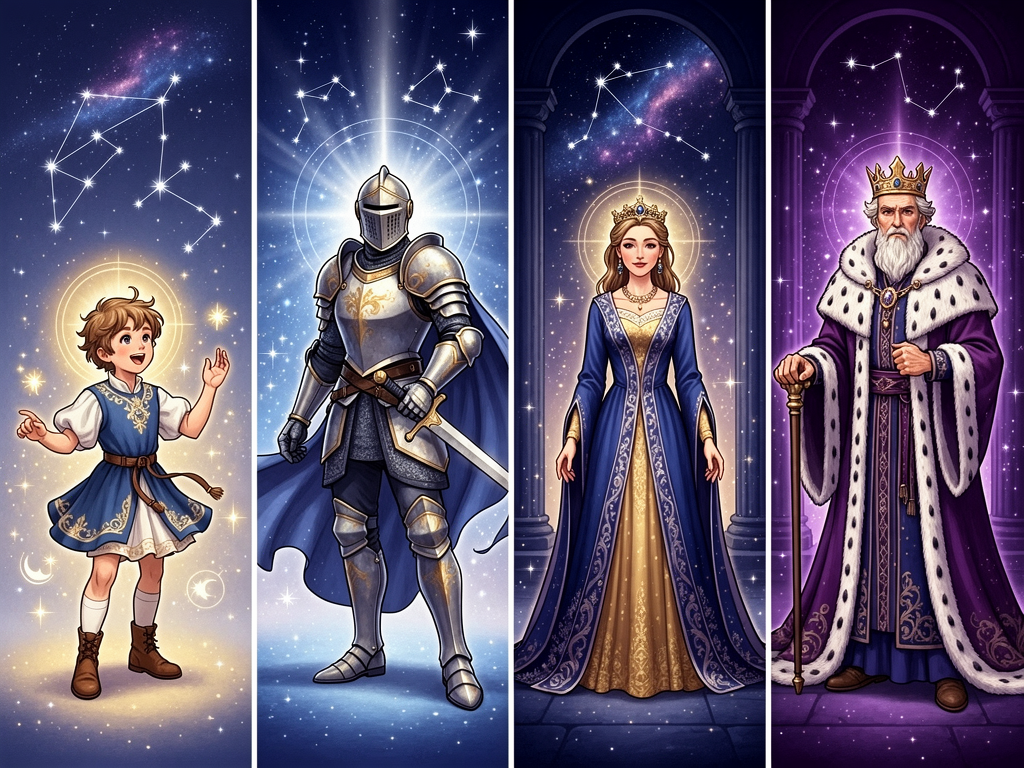
To understand a Court Card, you must first understand its rank. The progression from Page to King is not just a hierarchy of power; it is an evolution of maturity, mastery, and how one wields the element of their suit.
Pages: The Messengers and Students
Pages represent the spark of inception. They are the eternal students of the Tarot, carrying an energy that is youthful, curious, and open. Regardless of the querent's actual age, drawing a Page indicates a beginner's mind.
Pages are often associated with the element of Earth, which gives them a sense of grounding and potential. They are the seeds being planted. When a Page appears, it often heralds a new message, a fresh perspective, or an invitation to learn. They ask us: What are you curious about? Where are you being called to start fresh?
Knights: The Action-Takers and Extremists
If Pages are the idea, Knights are the action. Knights are associated with the element of Fire, bringing movement, momentum, and sometimes volatility to their suit. They are the teenagers of the Tarot court—passionate, deeply committed to their quests, but prone to taking things to extremes.
Knights do not sit still. They are either charging forward or fiercely defending their territory. When a Knight appears, the energy is shifting rapidly. They ask us: Where are you directing your focus? Are you moving too quickly, or perhaps not quickly enough? How can you channel your passion into purposeful momentum?
Queens: The Masters of Inner Expression
Queens represent a profound mastery of their suit, but their power is primarily directed inward. Associated with the element of Water, Queens are receptive, intuitive, and deeply connected to the emotional and psychological undercurrents of their element.
Unlike the Kings, who build structures in the outer world, Queens hold space. They lead by example, influence, and deep understanding. They have lived through the impulsivity of the Knight and have settled into a quiet, unshakeable confidence. When a Queen appears, she asks us: How are you nurturing yourself and others? Are you leading from a place of inner alignment and emotional intelligence?
Kings: The Masters of Outer Expression
Kings represent the outward mastery and externalization of their suit. Associated with the element of Air (and sometimes Fire, depending on the tradition), Kings are the architects, the directors, and the final authorities.
They take the raw elemental energy and build tangible structures, systems, and boundaries with it. A King is less concerned with the inner emotional landscape and more focused on real-world application, leadership, and responsibility. When a King appears, the call is to step up. They ask us: How are you taking authority over your life? What structures are you building to sustain your vision in the physical world?
Elemental Alchemy: Where Rank Meets Suit
To truly unlock the magic of the Court Cards, we must look at the alchemy that occurs when the innate element of the rank meets the element of the suit.
The suits are governed by the classical elements:
- Wands: Fire (Passion, action, spirit)
- Cups: Water (Emotion, intuition, relationships)
- Swords: Air (Intellect, communication, truth)
- Pentacles: Earth (Material world, body, resources)
When you combine the rank's element with the suit's element, you reveal the card's unique energetic signature.
Consider the Knight of Cups. The Knight’s innate element is Fire, but the suit of Cups is Water. Fire and Water create steam. Many practitioners believe this creates a dynamic tension, resulting in an incredibly romantic, idealistic, and sometimes emotionally volatile energy. He is driven by his feelings, charging forward on a quest for love or spiritual fulfillment.
Conversely, look at the Queen of Swords. The Queen is Water, but Swords are Air. Water and Air can create a crisp, clarifying winter storm or a refreshing breeze. She uses her emotional intelligence (Water) to deliver sharp, unclouded truth (Air). She is not unfeeling; rather, she cares enough to cut through the illusion and tell you exactly what you need to hear.
Understanding this elemental interplay allows you to move beyond rote memorization and begin intuitively feeling the personality of the card.
Practical Steps: How to Tell Who is Who in a Reading
So, how do you know if the King of Pentacles is your father, your own need for financial boundaries, or a call to adopt a pragmatic energy style? Here are practical steps to guide your interpretation:
1. Look at the Question: The phrasing of your inquiry is your strongest filter. If you ask, "How can I improve my relationship with my partner?" and draw a Court Card, it likely represents an energy style you need to adopt (e.g., the Queen of Cups suggesting more empathy). If you ask, "Who or what is influencing my career path?" it may very well be a literal person.
2. Observe the Surrounding Cards: Context is everything. If a Court Card is surrounded by Major Arcana cards, it often points to a profound internal psychological shift. If it is surrounded by active, daily-life Minor Arcana cards, it is more likely to represent a literal person or a mundane situation.
3. Notice the Direction of the Gaze: Where is the figure in the card looking? If the Page of Swords is looking directly at the next card in your spread—say, the Tower—it suggests that this youthful, curious energy is intimately connected to a sudden upheaval.
4. Trust Your Somatic Response: When you flip the card, pay attention to your body. Does a specific person instantly pop into your mind? Does your stomach tighten because you recognize a suppressed part of yourself? Your intuition will often bypass logic to hand you the correct interpretation.
The Council of the Court: An Actionable Practice
To deepen your relationship with these sixteen figures, intellectual understanding must eventually give way to personal experience.
This practice is designed to help you integrate the wisdom of the Court Cards into your daily life, moving them from abstract concepts into accessible inner guides.
The Practice: Calling the Inner Council
- Separate the sixteen Court Cards from your Tarot deck.
- Shuffle this mini-deck while holding an intention or a current challenge in your mind.
- Pull a single card. This card represents your "Inner Advisor" for the situation.
- Take out your journal and write a dialogue with this figure.
Reflection Prompts:
- If this Court Card were sitting across from me, what specific advice would they give regarding my current challenge?
- What aspect of this card's energy am I currently lacking or resisting?
- How can I embody the highest vibration of this card's maturity level today?
By engaging with the Court Cards not as confusing obstacles, but as wise advisors, mirrors, and energetic blueprints, you unlock a profoundly rich layer of your spiritual practice. They remind us that the journey of the Tarot is not just about universal forces or daily events—it is about the beautifully complex, ever-evolving human beings we are becoming.