The Architecture of Insight: An Introduction to the Celtic Cross
For over a century, the Celtic Cross has stood as the quintessential tarot spread. It is the layout most frequently encountered in guidebooks, the one most often requested by seekers, and the framework that has guided countless individuals through moments of profound uncertainty. While its exact origins are shrouded in the mists of esoteric history, many practitioners believe the Celtic Cross was formalized and brought into the public eye by Arthur Edward Waite and Pamela Colman Smith in the early 20th century.
What makes this spread so enduringly powerful is its elegant architecture. It does not simply offer a static snapshot of a single moment; rather, it provides a multidimensional map of a situation. It captures the intersection of the past and the future, the conscious and the subconscious, the internal self and the external environment. Just as astrological tradition suggests that the alignment of celestial bodies reflects our internal landscape, the spatial arrangement of these ten cards reveals the complex, interwoven architecture of our current reality.
Ultimately, this practice is designed to illuminate the unseen forces at play in our lives, offering clarity, agency, and profound self-reflection rather than rigid certainty. Tarot is a mirror, not a crystal ball. We do not use the Celtic Cross to make absolute predictions or medical claims; instead, we use it to understand the currents we are swimming in, allowing us to navigate with greater wisdom and grace.
The Anatomy of the Spread: The Cross and the Staff
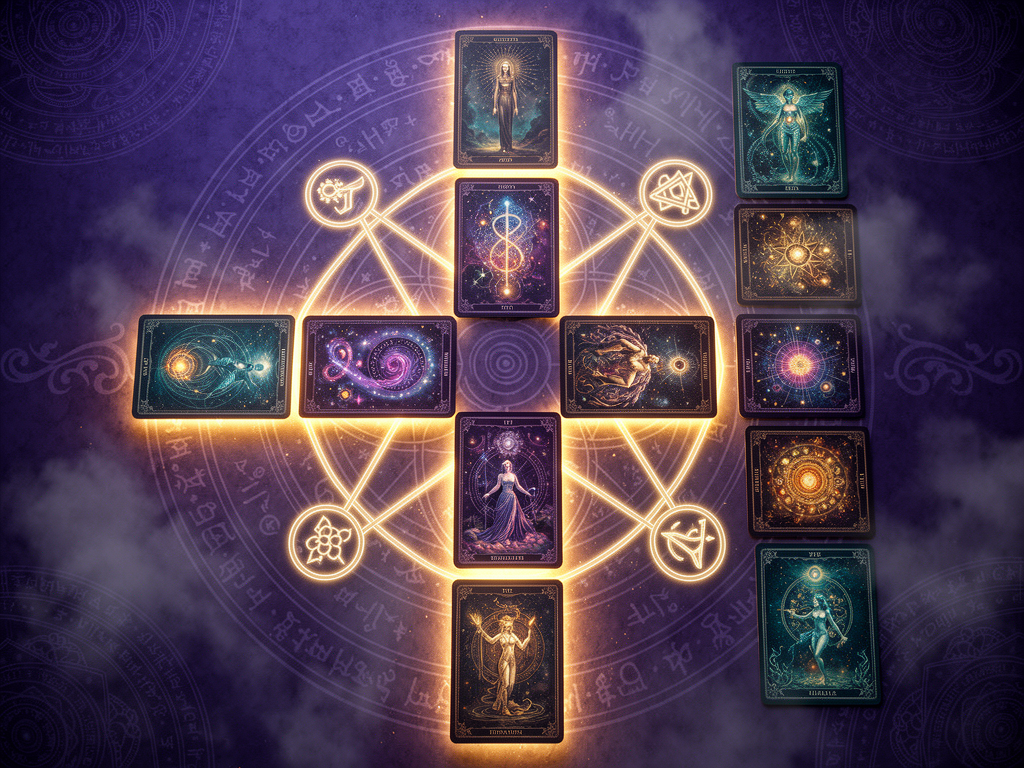
Before diving into the individual card positions, it is essential to understand the overarching structure of the Celtic Cross. The spread is divided into two distinct but deeply connected sections: The Cross and The Staff.
The Central Cross (Cards 1-6)
The first six cards form a cross shape. This section represents the microcosm—the seeker's immediate situation, internal landscape, and the direct forces acting upon them. It is the "here and now," framed by the immediate past and the approaching future. The cross itself is made of two axes: the vertical axis of consciousness (what is rooted in the subconscious versus what is consciously known) and the horizontal axis of time (the receding past and the approaching future).
The Staff (Cards 7-10)
The final four cards form a vertical line, or staff, to the right of the cross. This section represents the macrocosm—the seeker's relationship with the wider world. It moves from the internal self, outward to the environment, upward through psychological hopes and fears, and finally to the likely trajectory of the situation. The staff provides the context necessary to fully understand the central cross.
Decoding the 10 Positions
Let us explore the specific meaning of each position in this time-honored spread. As you read through these descriptions, remember that no card exists in isolation; each position speaks to the others.
Card 1: The Heart of the Matter (The Present)
Placed in the very center of the spread, this card represents the core of the issue at hand. It is the seeker's current state of being, the primary energy surrounding the question, or the central theme of the reading. If the reading were a novel, this card would be the main plotline. It anchors the entire spread, providing the foundational context for everything that follows.
Card 2: The Crossing (The Challenge)
This card is traditionally placed horizontally across the first card, symbolizing an obstacle, challenge, or complicating factor. It is the friction that creates the spark of the current situation. Even if this card is traditionally "positive" (such as The Sun or the Ten of Cups), its placement here suggests that there is too much of a good thing, a delay, or a blessing that is somehow blocking progress. It is the tension that demands resolution.
Card 3: The Root (The Subconscious)
Placed beneath the central cross, this card reveals the deep, often unconscious foundation of the situation. It represents the underlying beliefs, past traumas, or hidden motivations that are driving the current dynamic. Often, this card illuminates what the seeker is not fully acknowledging. It is the soil from which the current situation has grown, offering profound insight into the "why" behind the "what."
Card 4: The Recent Past (Departing Energy)
Situated to the left of the center, this position reflects events, influences, or energies that have recently transpired and are now beginning to recede. This is the timeline that has led directly to the present moment. Acknowledging this card helps to validate the seeker's journey, showing how their history has shaped the current challenge. It is the chapter that has just closed.
Card 5: The Crown (The Conscious Mind)
Placed above the central cross, this card represents what the seeker is consciously aware of, what they are actively focusing on, or what they aspire to achieve. It is the goal, the ideal, or the known potential of the situation. By comparing the Crown (Card 5) with the Root (Card 3), a reader can identify discrepancies between what the seeker thinks they want and what their subconscious is actually manifesting.
Card 6: The Near Future (Approaching Energy)
Located to the right of the center, this card indicates the immediate next steps or the energy that is flowing into the seeker's life. It is not a fixed fate, but rather the natural continuation of the present momentum. This card offers a glimpse into how the situation is likely to evolve over the coming weeks or months if no intentional changes are made to the current course.
Card 7: The Self (Current Attitude)
Moving to the base of the staff, Card 7 represents the seeker's current attitude, self-perception, and approach to the situation. It shows how they are showing up in the world right now. Are they feeling defeated, empowered, defensive, or open? This card is deeply empowering, as it reminds the seeker that their internal posture plays a massive role in how the external situation will unfold.
Card 8: The Environment (External Influences)
Directly above Card 7, this position reflects the external world. It encompasses the people, places, and cultural forces surrounding the seeker. It can represent the opinions of family and friends, the energy of a workplace, or the general atmosphere the seeker is navigating. This card helps differentiate between what is within the seeker's control (Card 7) and what they must learn to adapt to or set boundaries against (Card 8).
Card 9: Hopes and Fears (Psychological State)
Perhaps the most complex position in the spread, Card 9 reveals the seeker's deepest anxieties and highest aspirations regarding the situation. Because human psychology is deeply entwined with paradox, our greatest hopes are often inextricably linked to our deepest fears. This card sheds light on the psychological friction the seeker is experiencing, offering a profound opportunity for gentle self-inquiry and shadow work.
Card 10: The Outcome (The Trajectory)
The final card at the top of the staff represents the likely culmination of the current energies. It is vital to remember that tarot does not dictate destiny. This card simply shows where the path is leading based on the previous nine cards. If the outcome is undesirable, the seeker holds the power to change their actions, shift their mindset, and alter the trajectory. It is an invitation to conscious creation, not a sentence to be endured.
Weaving the Narrative: How to Read the Spread as a Whole
The true mastery of the Celtic Cross does not lie in memorizing the ten positions, but in the ability to weave them together into a coherent, resonant narrative. A skilled reader looks for patterns, echoes, and dialogues between the cards.
Begin by assessing the elemental balance. Are there many Cups, suggesting a highly emotional situation? A dominance of Swords, indicating intellectual conflict or anxiety? An abundance of Major Arcana cards implies that the seeker is moving through a period of significant, soul-level transformation, while a spread heavy with Minor Arcana suggests the focus is on the day-to-day, practical aspects of life.
Next, look for visual and thematic connections between specific axes:
- The Axis of Consciousness (Cards 3 and 5): Does the seeker's conscious goal align with their subconscious foundation? If a joyful card sits at the Crown but a card of heartbreak sits at the Root, the seeker may be using forced positivity to mask unhealed pain.
- The Axis of Time (Cards 4 and 6): How does the departing energy influence the approaching energy? Is there a clear progression, or is the seeker stuck in a repetitive loop?
- The Internal/External Dynamic (Cards 7 and 8): Is the seeker's internal state a match for their environment? A strong, empowered Self card paired with a chaotic Environment card suggests the seeker has the resilience to weather the storm around them.
Practical Steps for Your Next Reading
To truly integrate the wisdom of the Celtic Cross, approach the practice with intention and reverence. Here are practical steps to guide your next session:
- Set the Space: Clear your physical environment. Light a candle, burn some ethically sourced herbs, or simply take three deep, grounding breaths.
- Formulate the Inquiry: Avoid "yes or no" questions. Instead, ask open-ended questions such as, "What do I need to understand about my current career path?" or "How can I best navigate this transition in my relationship?"
- Shuffle and Draw: Shuffle the deck while focusing intently on your inquiry. When you feel ready, cut the deck and lay out the ten cards in their respective positions.
- Observe the Whole: Before diving into individual meanings, take a moment to look at the entire spread. Note the colors, the general mood, and any immediate intuitive hits.
- Journal the Journey: Write down your interpretations. The act of writing helps to synthesize the complex layers of the reading and provides a valuable record to reflect upon as the situation unfolds.
A Final Reflection
The Celtic Cross is a profound tool for spiritual navigation, a lantern held up in the dark. It asks us to look honestly at our past, to acknowledge our hidden fears, and to take responsibility for our future. It teaches us that while we cannot always control the environment we find ourselves in, we always have agency over how we respond.
Actionable Practice: Tonight, try casting a "mini" Celtic Cross using only the central cross (Cards 1-6). Ask the cards, "What energy is currently anchoring my life, and what challenge is asking for my attention?" Spend ten minutes journaling on the tension between the Root (Card 3) and the Crown (Card 5). What is blooming in your conscious mind, and what is nourishing it from the dark soil of your subconscious?