Humanity has always sought a dialogue with the unseen. Long before the advent of algorithms, data analytics, and digital forecasting, our ancestors looked to the flight of birds, the crackling embers of a fire, and the slow transit of the stars to find their bearings in an unpredictable world. Divination—derived from the Latin divinare, meaning to foresee or to be inspired by the divine—is frequently misunderstood in the modern era as mere fortune-telling or parlor trickery. Yet, a deeper, more respectful investigation reveals a profound, global tradition of seeking guidance beyond the purely rational mind.
At its core, divination is not about relinquishing free will to a predetermined fate. Rather, it is a sophisticated method of holding up a mirror to the soul. It invites the universe to speak through symbols, synchronicity, and intuition. By stepping outside the rigid confines of linear logic, we open ourselves to the deeper, ineffable currents of existence.
Let us embark on a respectful survey of several distinct divination traditions from around the globe, exploring the unique wisdom each brings to the human experience.
The I Ching: Harmonizing with the Book of Changes
Originating in China over three millennia ago, the I Ching, or Book of Changes, is one of the oldest and most revered oracular texts in the world. Deeply rooted in Taoist and Confucian philosophy, it is less a tool for predicting the future and more a profound philosophical guide for navigating the present moment.
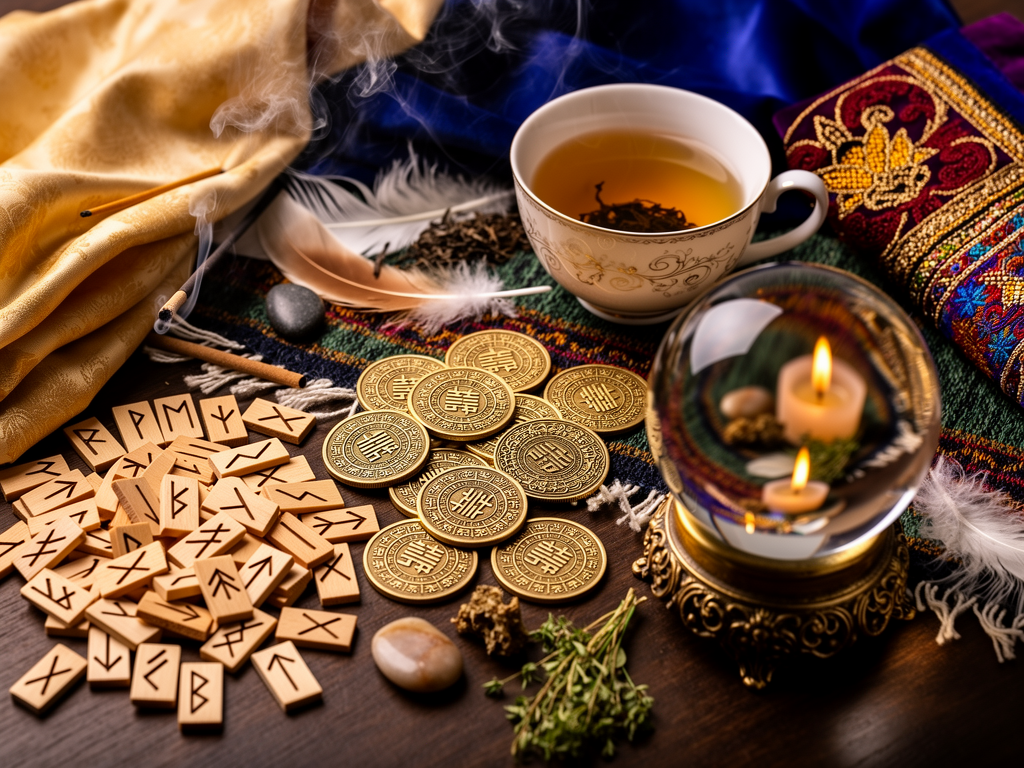
The system is based on the dynamic interplay of Yin (receptive, yielding) and Yang (active, creative) energies. By casting yarrow stalks or tossing coins, a seeker generates a hexagram—a figure composed of six stacked horizontal lines, which are either broken (Yin) or solid (Yang). There are 64 possible hexagrams, each representing a specific archetype or state of change in the natural world, such as "The Joyous," "The Cauldron," or "Darkening of the Light."
When consulting the I Ching, the seeker is not given a simple "yes" or "no." Instead, they are presented with a poetic landscape that reflects the underlying energetic dynamics of their situation. This practice is designed to help the individual align their actions with the Tao—the natural, effortless flow of the universe. It teaches that the only constant in life is change, and wisdom lies in knowing when to advance, when to retreat, and when to remain still.
Runes: Whispers of the Elder Futhark
Traveling to the cold, misty landscapes of ancient Northern Europe, we encounter the runes. The most commonly used system today is the Elder Futhark, an alphabet of 24 angular symbols historically carved into wood, bone, or stone by Germanic and Norse peoples.
Mythologically, the runes were not merely invented; they were discovered. Legend holds that the Allfather, Odin, hung himself from Yggdrasil, the World Tree, for nine days and nights, pierced by his own spear, to glimpse the runes in the depths of the Well of Urd. This myth underscores the profound sacrifice and deep introspection required to attain true wisdom.
In runic divination, or "casting the runes," a seeker draws symbols from a pouch or casts them onto a cloth. Each rune carries a multifaceted meaning—Fehu represents wealth and cattle, Isa denotes ice and standstill, Raido signifies a journey. Many practitioners believe that the runes do not dictate an unchangeable fate, but rather illuminate the threads of the Wyrd—the interconnected, ever-shifting web of past actions, present circumstances, and unfolding possibilities. Drawing a rune is an invitation to examine one's own internal landscape and take responsibility for the path ahead.
Scrying: Gazing into the Void
Scrying is a practice of gazing into a translucent, reflective, or dark surface to receive intuitive visions. Unlike the structured systems of the I Ching or runes, scrying is entirely unstructured, relying on the mind's ability to find meaning in the void. This tradition spans the globe, from the water-filled bowls of ancient Mesopotamia and the obsidian mirrors of Mesoamerican priests, to the crystal spheres of European mystics like John Dee.
The physical medium—whether it is a bowl of dark ink, a flickering candle flame, or a polished crystal—serves merely as a focal point. By staring into the medium and allowing the eyes to gently defocus, the analytical mind is quieted. This induces a mild trance state, allowing images, symbols, and intuitive flashes to rise from the subconscious.
Scrying requires immense patience and a willingness to trust one's inner vision. Astrological tradition suggests that the veil between the conscious and subconscious is particularly thin during certain lunar phases, making the time surrounding a full or new moon an ideal period for this contemplative practice. The visions received are rarely literal; they are the language of dreams, requiring personal interpretation and emotional resonance to be fully understood.
Tasseography: The Art of Tea Leaf Reading
Tasseography, the reading of tea leaves (or coffee grounds), emerged in the Middle East and found immense popularity in Europe during the 17th century. It is a beautiful example of finding the magical within the mundane. It transforms the simple, daily ritual of drinking a warm beverage into a moment of profound reflection.
The practice begins with the brewing of loose-leaf tea. The seeker drinks the tea, leaving a small amount of liquid and the leaves at the bottom of the cup. The cup is then swirled, often three times, and turned upside down on a saucer to drain. The practitioner then examines the patterns formed by the leaves clinging to the sides and bottom of the cup.
The cup itself is viewed as a map of the seeker's life. The rim often represents the present moment, while the bottom of the cup points to the distant future or deep-seated subconscious matters. Symbols might appear as animals, letters, or everyday objects. Tasseography is an inherently intuitive and intimate form of divination. It encourages the seeker to slow down, savor the moment, and recognize that guidance can be found in the most ordinary of places.
Bone Casting: The Wisdom of the Ancestors
Bone casting, or osteomancy, is one of the oldest forms of divination, practiced in various forms across Africa, Asia, and the Americas. It is deeply embedded in indigenous and animistic traditions, where the veil between the physical world and the spirit realm is viewed as permeable.
In many Southern African traditions, for example, a Sangoma (traditional healer) uses a collection of bones, shells, seeds, and carved objects, collectively known as "the bones." Each item in the collection has a specific spirit, meaning, or ancestral connection. When the bones are thrown onto a mat, the practitioner reads the relationships between the objects—how they land, which ones touch, and which ones face upward or downward.
This practice is not treated as a mechanical system, but as a living conversation with the ancestors and the spirits of the land. It is a deeply relational form of spiritual guidance. While bone casting is a closed practice in many indigenous cultures—requiring years of initiation and apprenticeship—learning about it broadens our understanding of how humanity connects to the divine. It reminds us that wisdom is not only found in books or abstract concepts, but in the earth itself and the lineage of those who walked before us.
The Common Thread: Cultivating Intuition
While the tools vary wildly—from ancient Chinese texts to the dregs of an Earl Grey tea—the underlying mechanism of all divination traditions is remarkably similar. They provide a structural framework for intuition to flourish.
We live in a hyper-rational society that often demands empirical proof and measurable outcomes. While this rationality has brought us incredible technological advancements, it can also leave us feeling disconnected from the deeper mysteries of the soul. Divination bridges this gap. It does not replace logical decision-making or professional advice; rather, it complements it by offering a different kind of data—emotional, energetic, and spiritual.
When we consult an oracle, we are essentially asking our higher selves to speak. The symbol we draw or the hexagram we cast acts as a mirror, reflecting our hidden fears, our unacknowledged desires, and our latent potential.
Practical Steps for the Modern Seeker
If you feel called to explore divination, it is essential to approach it with reverence, groundedness, and an open mind. Here are practical steps to integrate these ancient traditions into a modern spiritual practice:
- Choose a Tool that Resonates: You do not need to learn every system. Pay attention to what draws you in. Do you feel a connection to the earthy tactile nature of stones, the poetic philosophy of the I Ching, or the visual fluidity of water scrying?
- Create a Sacred Space: Divination requires focus. Before you begin, clear your physical space. Light a candle, burn some incense, or simply take three deep, grounding breaths to transition from the mundane to the mystical.
- Formulate Clear, Open Questions: Avoid asking passive, "yes/no" questions like, "Will I get the job?" Instead, ask empowering questions that invite insight, such as, "What energy should I embody during my upcoming interview?" or "What is blocking me from seeing this situation clearly?"
- Release Attachment to the Outcome: The oracle is not there to tell you what you want to hear. Approach the reading with neutrality. If a symbol appears challenging, view it not as a curse, but as an opportunity for growth and preparation.
- Journal Your Reflections: The true magic of divination unfolds over time. Keep a dedicated journal to record your readings. Note the symbols you received, your initial emotional reaction, and how the guidance played out in the subsequent days and weeks.
A Closing Reflection Practice
To begin cultivating your own intuitive dialogue with the world, try this simple, equipment-free practice today:
Take a walk outside with the specific intention of seeking guidance on a current dilemma. Before you step out the door, hold your question clearly in your mind. As you walk, let go of the need to actively "find" an answer. Instead, simply observe your environment. Notice what catches your eye—a strangely shaped cloud, a discarded playing card on the sidewalk, the sudden flight of a hawk, or the way two trees lean into one another.
When something arrests your attention, pause. Ask yourself: If this object or event were a message from the universe, what would it be saying to me? Trust the very first thought or feeling that arises. In doing this, you are participating in the oldest divination tradition of all: reading the living, breathing book of the world.