
The word "surrender" often conjures images of white flags, raised hands, and the bitter taste of defeat. In a modern culture that prizes relentless hustle, unwavering grit, and the illusion of absolute control, to surrender is frequently misunderstood as a failure. We are taught to push, to strive, and to force our will upon the world until it bends to our desires. Yet, when we look through the lens of profound spiritual inquiry, a very different truth emerges.
Surrender is not passivity. It is not apathy, nor is it abandoning your dreams when the road becomes difficult. True surrender is an active, dynamic state of grace. It is the conscious decision to release your rigid attachment to how things must happen, while maintaining a fierce, unwavering commitment to what truly matters. It is, perhaps, the most challenging spiritual practice of all, requiring a level of courage that far exceeds the brute force of mere willpower.
The Architecture of Control
To understand surrender, we must first examine its opposite: control. Human beings are natural meaning-makers and architects of the future. We find safety in predictability. When we set a goal—whether it is finding a life partner, achieving a career milestone, or healing a fragmented relationship—we immediately begin to draft a blueprint. We outline the timeline, the specific sequence of events, and the exact shape the outcome must take.
There is nothing inherently wrong with planning. However, many practitioners believe that our suffering begins when we mistake our blueprint for the only possible reality. When we grip the steering wheel of life too tightly, our knuckles turn white, our vision narrows, and our nervous system enters a state of chronic hyper-vigilance. We become so fixated on the specific door we want to open that we fail to notice the three other doors that have silently unlatched behind us.
Clinging to control is born from a quiet, persistent fear: the fear that if we do not manage every variable, the universe will drop us. It is a fundamental lack of trust in the unfolding of life. Yet, the paradox of control is that the tighter we grip, the more we suffocate the very intentions we are trying to nurture. Like holding water, the harder you squeeze your hand, the faster it slips through your fingers.
Letting Go vs. Giving Up
Navigating the terrain of surrender requires us to make a vital distinction between letting go and giving up. While they may look similar from the outside, their internal landscapes are entirely different.
Giving up carries the heavy, stagnant energy of defeat. It is rooted in despair, apathy, and a sense of victimhood. When you give up, you abandon your desire entirely. You collapse under the weight of disappointment, concluding that because the outcome did not manifest exactly as you demanded, the desire itself was flawed or impossible. Giving up says, "This isn't working my way, so I am walking away."
Letting go, on the other hand, is an act of profound trust and spaciousness. It is an acknowledgment of your own limitations. When you let go, you do not abandon your core desire; you simply fire yourself from the position of General Manager of the Universe. You remain devoted to the essence of your intention—love, purpose, peace, abundance—but you release the rigid specifications of the packaging it must arrive in.
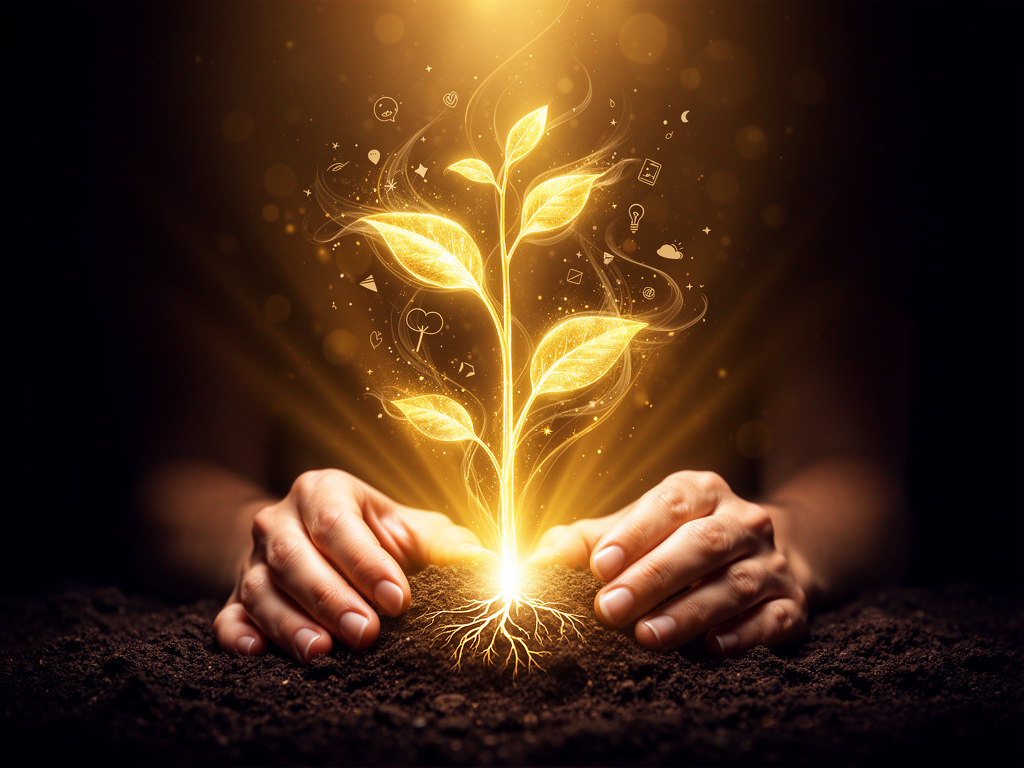
Imagine you are planting a garden. Giving up is throwing the seeds on the ground, demanding they bloom by Tuesday, and then paving over the soil when they do not. Letting go is planting the seeds with care, watering them, pulling the weeds, and then trusting the sun, the soil, and the rain to do their work in their own time. You remain committed to the garden, but you surrender the timeline and the exact height of every stem.
Ancient Wisdom Meets Modern Understanding
This delicate balance between effort and release is a cornerstone of many ancient wisdom traditions. In Taoist philosophy, this is beautifully encapsulated in the concept of Wu Wei, often translated as "effortless action" or "non-doing." Wu Wei does not mean doing nothing; it means aligning your actions with the natural flow of life, rather than swimming furiously against the current. It is the wisdom of the river, which carves through rock not by sheer force, but by persistent, yielding flow.
Similarly, in the eight limbs of Yoga outlined by Patanjali, we find the practice of Ishvara Pranidhana, which translates to surrendering to a higher source or the ultimate reality. It is an invitation to offer the fruits of our actions to something greater than our individual egos. We do the work, we practice with devotion, but we relinquish our claim on the results.
Astrological tradition suggests that certain planetary transits, particularly those involving the outer planets like Neptune or Pluto, invite us into periods of profound surrender. These cosmic seasons often dismantle our carefully constructed plans, asking us to dissolve our egoic attachments and trust the deeper, unseen currents of our lives. While we cannot control the weather, we can learn how to adjust our sails.
In modern terms, surrender can be viewed through the lens of nervous system regulation. When we are trapped in a cycle of over-controlling, our bodies are often locked in a sympathetic nervous system response—fight or flight. We perceive the unpredictability of life as a threat. Surrender is the process of gently guiding the body back into the parasympathetic state—rest and digest. It is a somatic realization that we are safe, even when we do not know what happens next. This practice is designed to help you release the grip of the ego, allowing a deeper sense of physiological and spiritual ease to emerge.
The Somatics of Release
Because surrender is a holistic experience, it cannot be achieved through intellectualizing alone. You cannot simply think your way into letting go; you must allow your body to experience it.
Notice how your body feels when you are trying to force an outcome. Your jaw is likely clenched, your shoulders creep toward your ears, your breath becomes shallow, and there is a sensation of contraction in your chest or stomach. This physical constriction is the ego's attempt to brace against uncertainty.
When true surrender occurs, there is an unmistakable somatic shift. It often feels like a deep, involuntary exhale. The shoulders drop. The belly softens. The mind, previously spinning with anxious calculations, settles into a quiet, observant stillness. It is not a feeling of getting what you want; it is the profound relief of no longer needing to micromanage reality. It is stepping off the battlefield of your own making.
Practices for Everyday Surrender
Cultivating the art of surrender is a lifelong practice. It is not a one-time event, but a daily, sometimes hourly, choice to unclench our spiritual fists. Here are several practical ways to weave the magic of surrender into your daily life.
1. Shift from Expectations to Intentions
Expectations are rigid; they demand a specific return on investment. Intentions are directional; they set a course but remain open to the journey. Begin by examining your deepest desires. Can you distill them down to their essence? If your expectation is "I must get this specific job by next month," the underlying intention might be "I intend to share my gifts in a role that brings me financial stability and creative fulfillment." By focusing on the intention, you open yourself up to opportunities that your ego may not have considered.
2. Practice Micro-Surrenders
Do not wait for a major life crisis to practice letting go. Build your "surrender muscle" through small, everyday moments. When you are stuck in traffic, instead of gripping the steering wheel in frustration, use it as an opportunity to practice acceptance. Notice the resistance, take a deep breath, and consciously soften your body. When a minor plan falls through, practice saying, "I release my need for this to happen exactly as I envisioned." These micro-surrenders train your nervous system to tolerate uncertainty without panicking.
3. The "Even If" Exercise
Much of our inability to surrender stems from the fear of a worst-case scenario. When you find yourself obsessing over an outcome, gently walk yourself through the "even if" process. "Even if I don't get the promotion, I will still be okay. Even if this relationship ends, I am still whole." This is not about manifesting negativity or making absolute predictions; rather, it is about neutralizing the terror of the unknown. When you realize that your core self can survive disappointment, the desperate need to control the outcome begins to dissolve.
4. Cultivate Awe and Humility
Spend time in environments that remind you of your small, beautiful place in the vastness of the universe. Stand before the ocean, walk through an ancient forest, or simply gaze at the night sky. Nature is the ultimate teacher of surrender. The seasons do not force their transitions; the tide does not apologize for its retreat. Immersing yourself in the natural world fosters a sense of humility, reminding you that there is a profound, intelligent rhythm to life that operates entirely without your supervision.
The Ultimate Power
Ultimately, letting go without giving up is the discovery of true spiritual power. It is the realization that while you cannot control the waves, you can learn to surf. By relinquishing the heavy burden of the "how," you free up an immense amount of energy to pour into the "what"—your presence, your devotion, your character, and your love.
Surrender is the quiet confidence that whatever comes your way, you will have the wisdom to meet it. It is an invitation to stop fighting the current and allow yourself to be carried toward shores you never could have imagined.
A Reflection Prompt for Your Practice
Take a moment today to sit quietly with a journal. Bring to mind an area of your life where you feel a deep sense of friction, anxiety, or exhaustion from trying to orchestrate the outcome. Ask yourself: What is the core essence of what I am seeking here? And what specific details, timelines, or expectations am I willing to gently release today, in order to make room for something even greater?